
What a Longmont Resident Lookup Can Confirm
The strongest first source depends on the question. An assessor can connect a person to an owner-of-record parcel. A deed can show a grantor or grantee role. A voter lookup can match a registered voter’s own address and status. A court docket can locate a case event, while the clerk holds the file. A directory, obituary, or archive can support family history and a former-address trail. Treat each result as evidence with a defined scope, not as a complete identity profile.
| Record | What it confirms | Where to search | Access |
|---|---|---|---|
| Assessor parcel | Owner of record, mailing and situs, legal description | Boulder or Weld property portal | Free standard search |
| Recorded deed | Grantor, grantee, instrument, recording date, parcel link | County recorder index and office | Index plus copy routes |
| Voter registration | Registered person’s stated address, status, precinct, public fields | Go Vote or county data request | Personal match or request |
| Court docket | Case event, party, court, date, division, case number | Colorado Judicial Docket Search | Docket public; file by clerk |
| Vital record | Eligible birth, death, marriage, adoption, or divorce record | County, CDPHE, court, or Archives | Confidential and eligibility-based |
| Directory or archive | Historical address, occupation, family, event, or image clue | Library, LGS, Museum, DPL, LOC | Edition or appointment rules |
Run an address-bearing source before relying on a name-only result. Longmont’s county line means a “Longmont” hit can belong to Boulder or Weld. Save the account, parcel, legal description, voter county, precinct, case number, or directory year that makes the result reproducible.
The Boulder County court route is the source screen for the court-record path in this coverage map.
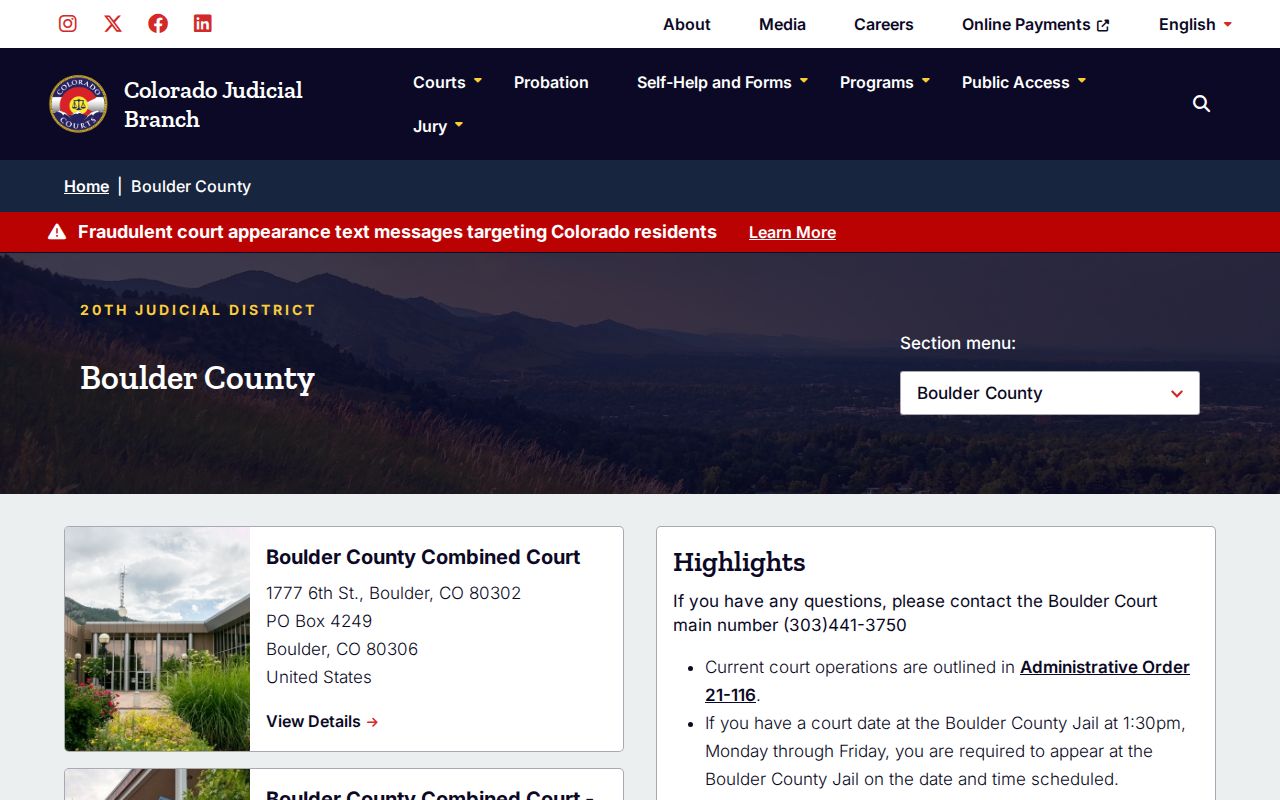
The Boulder County court route shows why a resident lookup needs both an online starting point and a clerk or records request path.
Build a Longmont Name-and-Place Hypothesis
Write down the full name, middle initial, alternate spelling, former surname, approximate age, known address, county, occupation or organization, and time period before searching. A name can move between Longmont, Boulder, Weld, a rural route, and a post-office heading. OCR can change a surname. A married name can break a directory trail. The point is not to collect every possible hit. It is to define the person you are trying to distinguish from same-name records.
Start with a parcel, deed, or personal voter match when the goal is a current address clue. Start with a city directory, Ledger card, newspaper, cemetery, or Museum collection when the goal is historical. A business filing or professional license can connect a person to an entity or credential, but a registered-agent or license address is not proof of residence.
Keep a source log with the URL, retrieval date, record number, exact name, county, and what the result actually says. Label a result as confirmed, compatible, unresolved, or contradicted. That small discipline prevents an old directory occupant, a current owner, and a court party from becoming one person by accident.
The Longmont Resident Lookup Stack
A current resident lookup works best as two independent keys. A common example is assessor owner plus deed grantee. Another is a directory address plus census household. A voter match plus a court party can fit when the middle name, county, date, and attorney align. These sources work in sequence, but none is a complete resident directory.
| Layer | Useful clue | Do not infer |
|---|---|---|
| Assessor | Owner, situs, mailing, parcel, values | Every person living there |
| Recorder | Legal transfer, parties, legal description, date | Current occupancy |
| Voter | Registered person, address, status, precinct | Every adult or ballot choice |
| City portal | Applicant, permit, inspection, board, or public participant | Resident status from a city role |
| Directory or obituary | Past address, occupation, household, event | Current identity without date checking |
For property and deed records, run Boulder and Weld separately when the parcel is not already known. For court work, choose the county or courthouse filters separately. For a birth, death, marriage, adoption, or divorce record, use the official application route and eligibility rules. A result that cannot be legally released is not a search failure; it is a boundary of the record system.
Longmont Docket Search Fields Matter
The Colorado Judicial Docket Search requires a date plus at least one other filter. It offers judicial district, county, courthouse, court type, division, date range or specified date, four-digit year, case class, case sequence, individual or business party, first and last name, and attorney name or bar number. For Longmont, test Boulder and Weld, then check the municipal court route if the matter concerns the Longmont Municipal Code or Charter.
| Location filters | Judicial district, county, courthouse, court type, and division. |
|---|---|
| Date and case | Date range, specified date, four-digit year, case class, and case sequence. |
| Party mode | Individual or business, first name, last name, and business name. |
| Attorney mode | Attorney name or bar number, with first and last name options. |
| Result scope | Docket list and event context. The court file, disposition, or decree comes from the clerk. |
Run a name variant only after selecting a date and county. A docket result can contain courthouse, division, case number, party, attorney, and date fields. It may omit the image, disposition, sealed material, or the detail needed to prove what happened. A paid register-of-actions service is limited and not the official record. Use the court request route for the record itself.
The Weld County court route is the source screen for the county-specific records path.
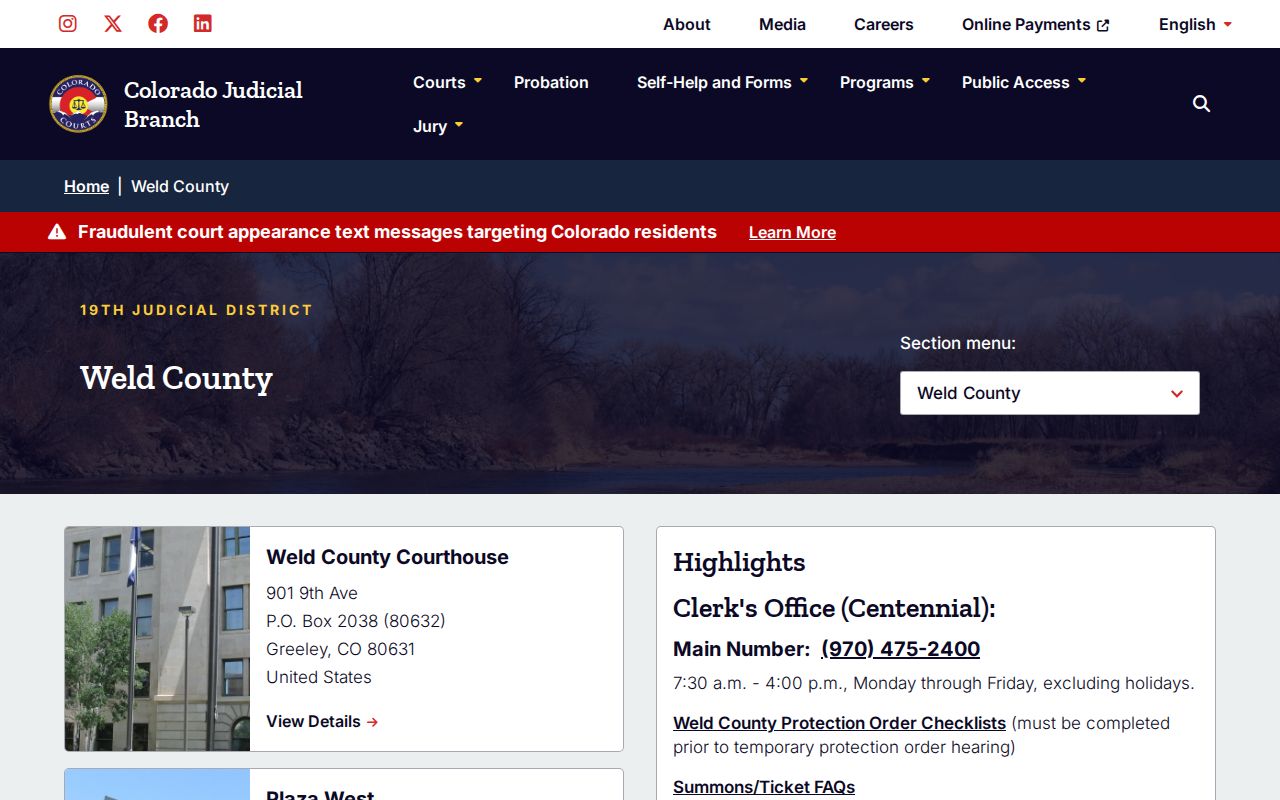
The Weld County court route keeps the county split visible. A Longmont name should not be run through only one judicial district.
Verify One Longmont Resident with Three Records
Verification is a process of compatible details, not a pile of hits. Use an address-bearing record first. Then compare a second record with a different keeper and a third source that fits the same time period. Keep ownership, voter status, court appearance, and historical household role in separate notes.
- Normalize the person’s name and collect the known county, approximate age, address, ZIP, or date.
- Anchor the name to an assessor parcel, recorded deed, or personal Go Vote result. Save the parcel or precinct key.
- Run Boulder, Weld, and Longmont Municipal Court paths as the event requires. Match case year, middle name, attorney, and location.
- Use a directory, census, obituary, business filing, or license only when its date and role support the same person.
- Request a certified or complete record from the custodian when an index result must be relied on.
- Docket
- A court’s list of scheduled or recorded case events. It is not the full case file.
- Index versus image
- An index is a finding aid. An image or file is the underlying record, and access or fees may differ.
- Certified copy
- A copy issued or attested by the custodian as an official copy for an eligible request.
Stop at two compatible identifiers if the remaining detail is restricted or uncertain. A same-name collision is the normal risk in a Longmont resident lookup. Record the inference as unverified instead of filling the gap with a guess.
Longmont Custody Results Need Context
Colorado’s CBI Internet Criminal History Check is a Colorado-only, name-based channel with a $6 internet fee. It excludes categories such as sealed and juvenile records and limited traffic matters. A processed or notarized route has different requirements and a $13 fee. A CBI result is not identity proof and should be checked against the court file for disposition.
The Colorado CBI name-search route is the source for the limited criminal-history channel.
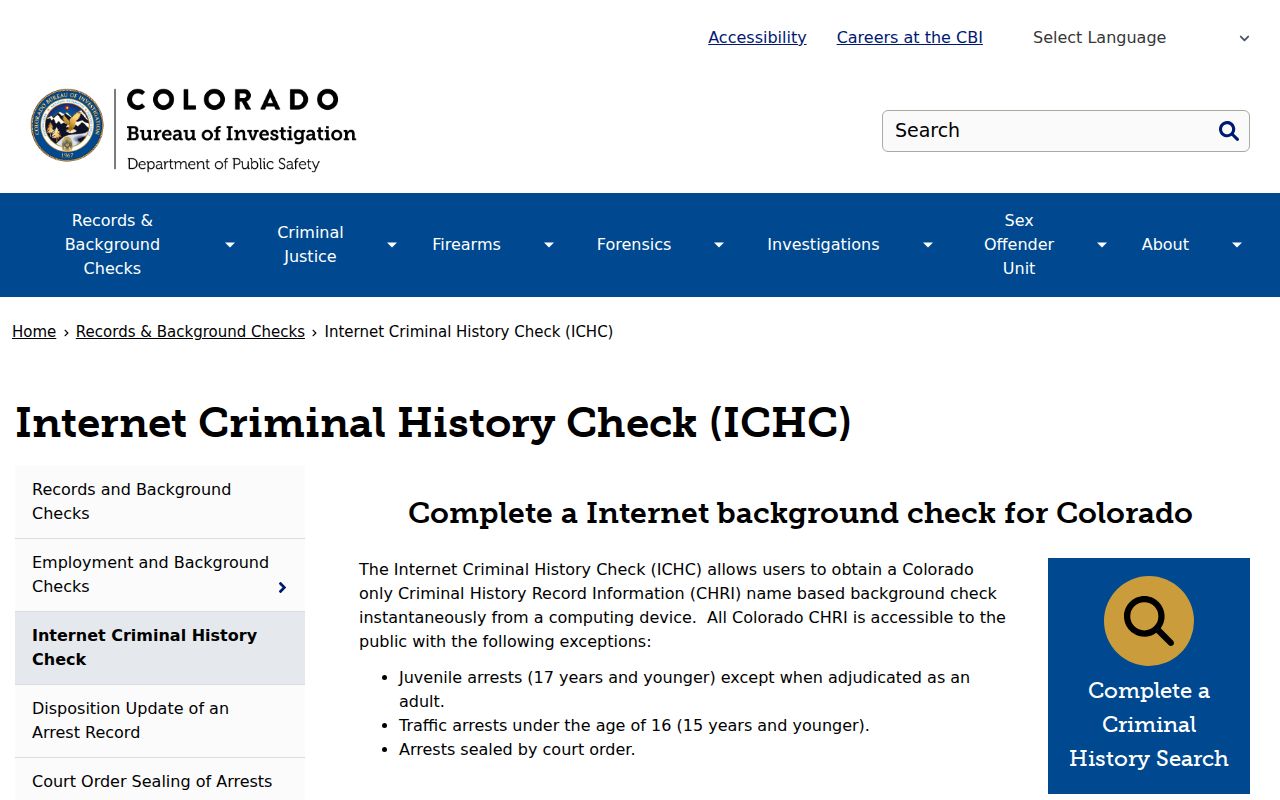
The Colorado CBI name-search route describes its exclusions and fee. Those limits are part of what the result means.
Boulder County’s daily jail listing is a current booking and release report and says it is not the official record. Weld has separate daily arrest and released tools. Colorado DOC searches state custody, while the federal Bureau of Prisons locator covers federal custody from 1982 to present. Colorado VINE supplies custody notifications. None of these results proves guilt, present residence, or the final case outcome.
The Boulder jail listing and booking reports are the source for the current snapshot shown here.
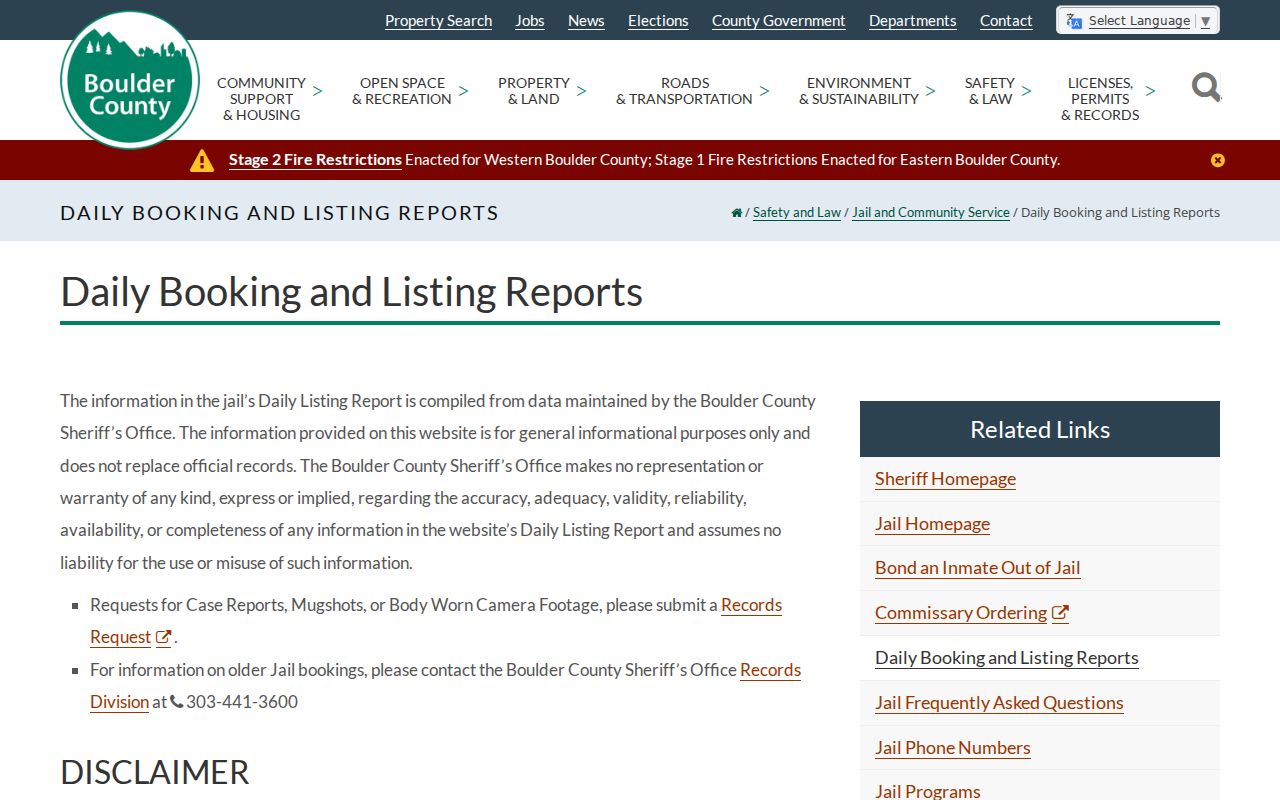
The Boulder jail listing is a current snapshot with a stated “not official record” limit. Use the Sheriff Records Section or court clerk for older or complete material.
The Colorado adult registry search is the source for the registry screen and its identity warning.
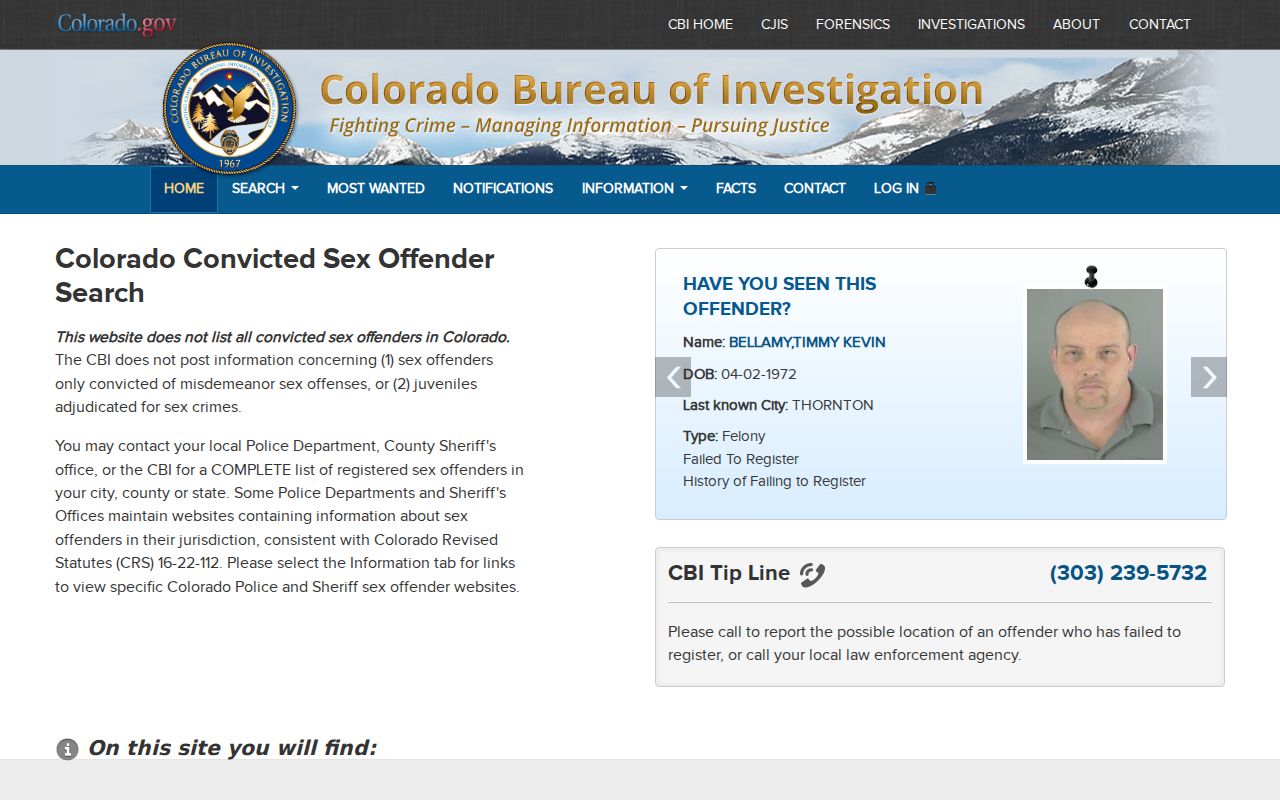
The Colorado adult registry carries its own identity and lawful-use warnings. Treat an address or name as a narrow status lead, never as a complete resident match.
Longmont Vital Records Are Confidential by Design
Colorado vital statistics are confidential under C.R.S. §25-2-117. Birth, death, marriage, civil union, adoption, and divorce-related records are not a general public name index. An eligible applicant needs identification and a direct and tangible interest or qualifying relationship. Boulder’s Longmont service at 515 Coffman handles eligible local requests; Weld routes Weld events through its offices; CDPHE handles state orders and explains the application process.
The Colorado vital records page is the right starting point for eligibility and ordering. A local counter, mail route, or state application may be available, but none is a public name-browse tool.
The State Archives holds collection-specific historical material, including Boulder County birth groups from 1870-1909 and death-related collections such as the Boulder Register of Burials for 1895-1897 and Coroner’s Reports for 1909-1912. These are catalog and request routes, not a blanket public release of every certificate. Family-history researchers often use the Ledger, newspapers, cemetery and mortuary indexes, directories, census, probate, and Archives together.
Adoption searches use the Colorado Voluntary Adoption Registry and controlled consent or relationship rules. A general public resident lookup cannot infer a birth relationship from an obituary, directory, or same-name record.
Longmont Archive Gems for One Person
The Longmont Genealogical Society’s WPA-derived Ledger project is a strong historical bridge. Its index covers notices from 1879 through 1935, while the 1898-1919 voter extraction adds address, ward, age, occupation, marital status, and physical description. The Quarterly Index points to street, election, naturalization, school, water-permit, and organization subjects. These sources can turn a vague surname into a date-and-place research question.
For a former classmate, the Library, Museum Archives, yearbooks, city directories, newspapers, and census are better routes than a current record. For an heir, connect an obituary or cemetery lead to probate and then the recorder. For a business owner, compare the Colorado Secretary of State filing with DORA, a local permit, and the parcel, keeping the registered-agent address separate from residence.
The 1915 William Henry Dickens case at 303 Coffman Street is a tightly sourced police-history lead held in Denver Public Library case papers. It illustrates a safe research pattern: distinguish victim, witness, officer, household, and property roles before using a place-name match.
Note: Local history is strongest when the source role and the time period stay attached to the name.
Legal Limits on a Longmont Resident Lookup
Colorado’s Address Confidentiality Program provides a substitute address and mail forwarding for eligible survivors of domestic violence, sexual offense, stalking, or human trafficking, and for covered health-care workers. Voter confidentiality can withhold protected information, and HB25-1195 creates a confidentiality route for qualifying first responders and spouses. DMV records are protected under the Driver’s Privacy Protection Act. A public deed can also contain a mailing address that should not be republished without a clear need.
Colorado stalking and harassment laws matter even when the starting record is public. Use the narrowest record needed for genealogy, reconnecting, civic research, house history, or personal safety. Do not publish a current address because an index exposed it. If a result is wrong, contact the assessor, recorder, clerk, court, voter custodian, DORA, CBI, or city records office that created it. Preserve the source date and record number for a correction request.
Lawful personal use. A Longmont resident lookup is for careful, lawful research. Do not use records to stalk, harass, threaten, intimidate, or harm anyone.
- Same name, different county or date: require a second address, parcel, age, or family key.
- Docket with no file image: request the case file or disposition from the clerk.
- Vital-record name-only search: use the eligibility application or historical indirect sources.
- Protected or confidential address: stop and do not try to reverse the substitute address.