
How Longmont Residents Are Found
Start with the key already in hand. A street address points first to the Boulder or Weld assessor, a known owner points to the property roll and recorder, and a historical surname may belong in a directory or newspaper rather than a current lookup. The city’s own records also expose people connected with boards, permits, easements, council material, and public meetings. None of these sources is a complete Longmont residents directory. Each is a record of a role, parcel, event, or time period.
Use a short, repeatable chain. Keep the original address, the county returned by the parcel search, the record date, and the source URL. Then compare the result with an independent key. A deed grantee and assessor owner may match without proving occupancy. A directory address and census household may fit without proving title. That distinction keeps a useful Longmont resident search from turning a clue into a claim.
- Normalize the address with the official USPS lookup, but use the parcel to choose Boulder or Weld County.
- Search the county assessor by address, owner, street, subdivision, account, parcel, or section-township-range where available.
- Use Go Vote Colorado for a person’s own registration status, or request a lawful county or state voter report.
- Read the recorder index for deeds, plats, liens, and legal descriptions, then inspect the actual instrument when needed.
- For an older household, move to city directories, the Longmont Ledger index, census material, newspapers, and archives.
When an online index ends, the fallback is not guesswork. Try the county counter, office phone or email, mail or drop box, a library database, a Museum Archives appointment, or a Colorado Open Records Act request to the custodian.
Longmont Resident Records and County Lines
Longmont sits across Boulder and Weld Counties. The city’s outside-agency resource map makes that split explicit, but the practical test is the parcel and its legal description. Boulder County handles most city records; eastern and southeastern addresses can fall in Weld County. A mailing line that says Longmont does not identify the recorder, assessor, court, or election custodian.
The Boulder County public-records hub links recording, property, permits, elections, and birth records. Weld’s Clerk and Recorder works from Greeley and exposes real-estate records from 1865 through its EagleWeb index. City records remain a separate layer at the Longmont Clerk, city court, Accela, Museum, and library. These offices form the working backbone of a Longmont residents directory.
The county split is visible in the Longmont outside-agency resource map. Use it as an orientation aid, then verify the parcel with the county system.
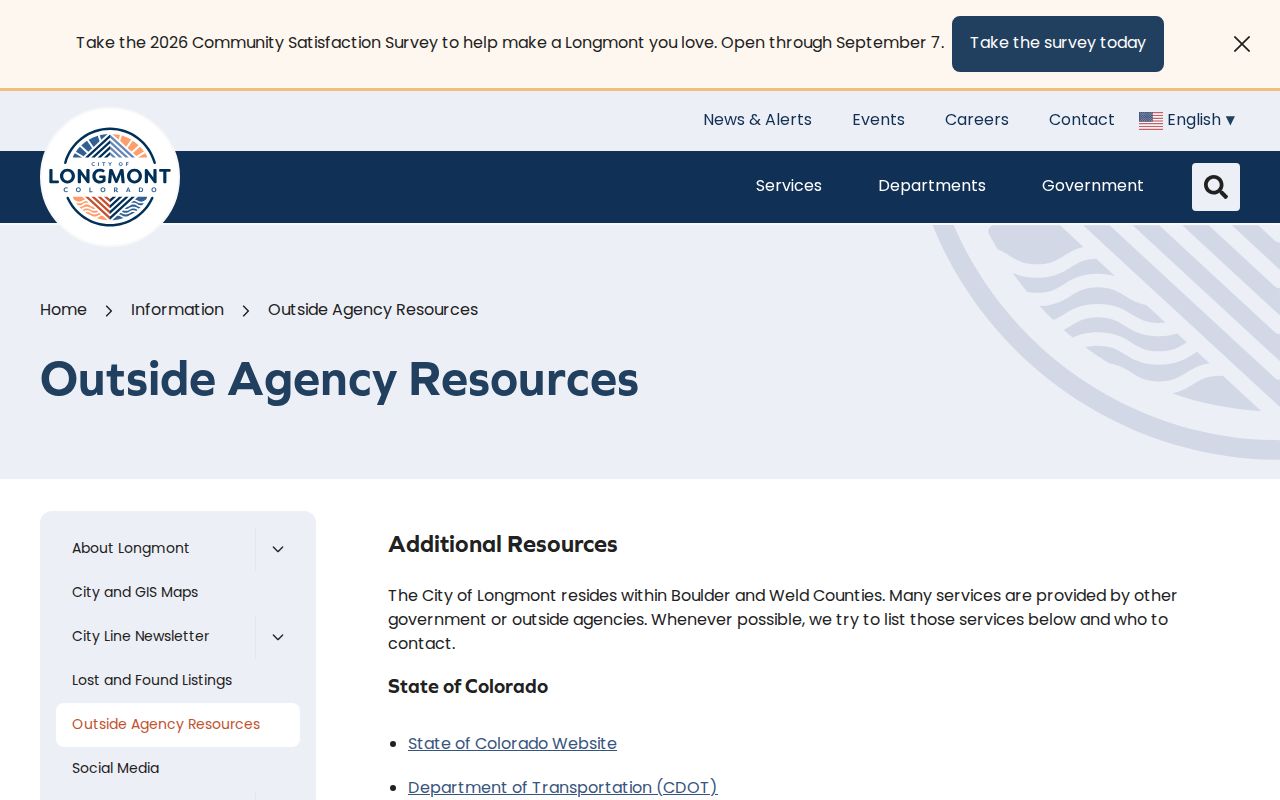
The county-jurisdiction screen makes the Boulder-Weld split concrete. It does not replace the parcel search that decides which office holds a record.
The Boulder County public-records hub is the county-side starting point for recording, property, permits, elections, and other public record routes.
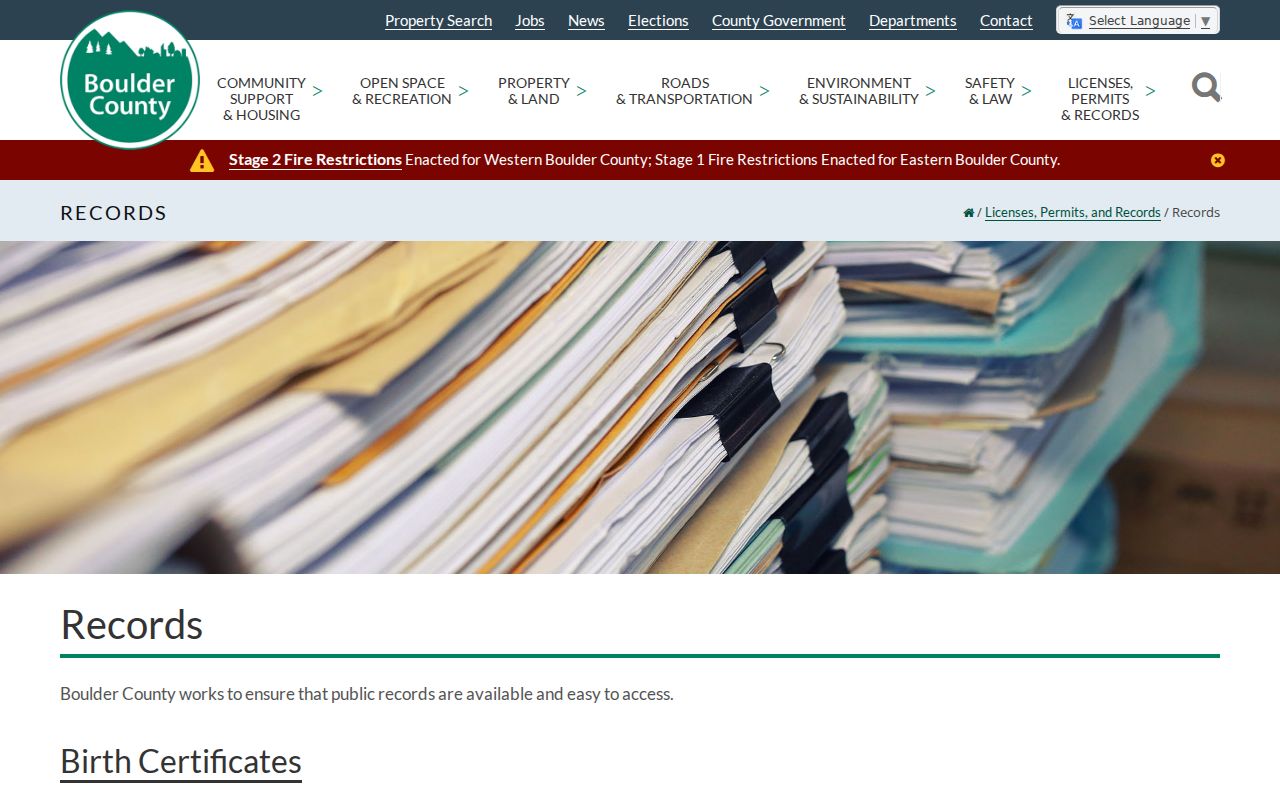
The county hub gives a county-side starting point, while the parcel and document custodian still control the final record path.
Boulder County Clerk and Recorder
1750 33rd St., Suite 201, Boulder; Longmont drop box at 529 Coffman St.
Recording, elections, licenses
Boulder recorded-document and public-record routes
Weld County Clerk and Recorder
Recording Department, 1250 H Street, Greeley
970-304-6530
Real estate, maps, elections, and marriage records
Longmont City Clerk
350 Kimbark St., Longmont, CO 80501
303-651-8649
City records, imaging, indexing, archives, and CORA
Note: County choice follows the parcel, not the postal city printed on an envelope.
The Longmont Directory Starts with a Parcel
Boulder County Property Search accepts an address, owner name, street name, subdivision, account, parcel, or section-township-range search. A map click can reach the same parcel when an address is misspelled or a historic street line is unclear. Save the account, parcel, owner, mailing address, situs address, legal description, sales history, and election district before moving to another source. The property card is an ownership and assessment record, not a list of every person at the property.
| Address | Physical situs search; exact or partial behavior depends on the live portal. |
|---|---|
| Owner name | Current assessed owner; compare names, trusts, estates, and entity spellings. |
| Street name | A starting point for a street-wide browse, followed by parcel numbers. |
| Subdivision | Connects lots, blocks, plats, additions, and older legal descriptions. |
| Account or parcel | Durable county identifiers that bridge assessment, GIS, permits, and deeds. |
| S-T-R | Section-township-range search useful for rural or county-side property. |
Weld uses a different vocabulary: account number, owner name, address portion, subdivision with block and lot, parcel number, section-township-range, and API number. The Weld report can show tax year, buildings, values, owner and mailing fields, land description, acres, and square feet. A searcher who tests both systems with the right field set is less likely to mistake an empty result for an absent record.
Colorado Voter Lookup Has a Narrow Key
The Go Vote Colorado registration tool is a personal status lookup. It asks for first name, last name, date of birth, and residential ZIP. It can return a registration status, mailing address, precinct or district, party affiliation, ballot status, and update choices for the person who matches those fields. It is not a public street browse and it does not publish a full household list.
Boulder County describes public voter reports with names, addresses, party, status, birth year, precincts, districts, and election participation. Weld supplies list and file products through its elections office, and the Secretary of State offers report forms. Month and day of birth, signature, email, driver-license number, Social Security number, and confidential voter information are withheld. Election history can show whether and how a ballot was recorded, not how a person voted.
A voter match is useful confirmation for a registered voter’s stated address. A missing match proves little. A person may be unregistered, newly moved, confidential, protected through the Address Confidentiality Program, or in a different county extract. Keep voter evidence in its own column beside, not inside, the property and deed evidence.
The Go Vote Colorado portal illustrates the personal lookup fields. It is a status tool, not a public street roster.
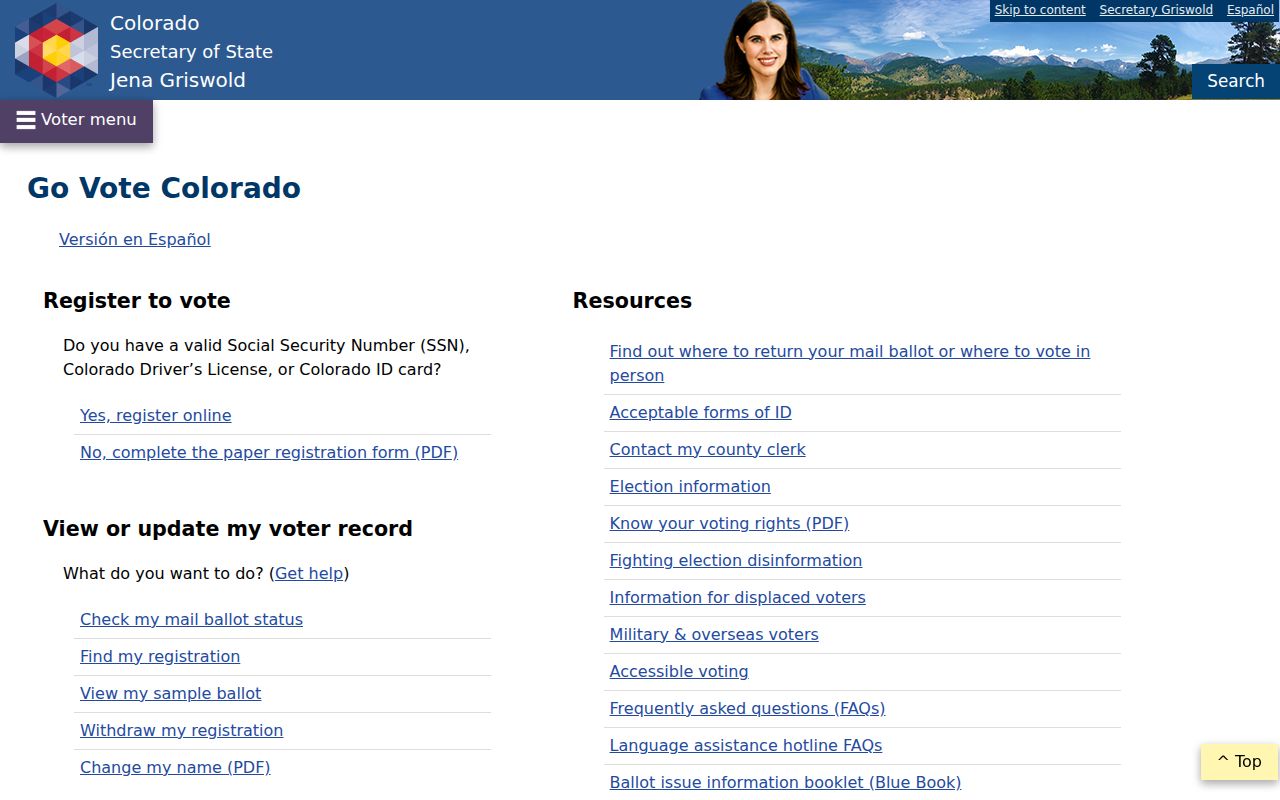
The Go Vote screen reinforces the need for a name, birth date, and residential ZIP match. County extracts have a different request route.
Note: A current voter result and an assessor owner result answer different questions even when the names match.
Current Longmont Resident Sources
Current directory-like sources in Longmont are purpose-built records. The assessor is strongest for title and parcel clues. The voter system is strongest for a registered person’s status. The recorder supplies legal transfers, while city portals expose named applicants, speakers, board members, permit participants, and public correspondents. Neighborhood groups can add civic context, but the public NGLA material does not expose a household roster.
| Source | Names or clues | Keeper | Access |
|---|---|---|---|
| Assessor parcel card | Owner, mailing and situs addresses, parcel, sales, building data | Boulder or Weld Assessor | Free public search |
| Recorded-document index | Grantors, grantees, legal descriptions, deeds, liens, plats | County Clerk and Recorder | Index and office copy routes |
| Voter registration | Registered name, stated address, status, precinct, public history fields | Colorado SOS or county clerk | Personal lookup or request |
| Longmont city records | Applicants, officeholders, speakers, board members, named parties | City Clerk and city portals | Self-service or CORA |
| Directories and indexes | Historical household, occupation, address, event, or obituary lead | Library, LGS, archives | Online, in-library, or appointment |
The sensible order is owner or address first, then a second independent source. A resident who is not the titleholder may appear only in a directory, voter file, newspaper, board record, or court index. Conversely, a deed party can be an estate, trust, lender, or former owner. That is why a reliable Longmont residents directory is a set of linked trails rather than one master roll.
Longmont City Records Name Civic Participants
The Longmont Online Records portal includes annexation, boards and commissions, building permits, budgets, council minutes, easements, election administration, election campaigns, urban-renewal records, ordinances, resolutions, and subdivision documents. Its full-text instructions support searches across minutes, ordinances, resolutions, and easements, with wildcard options. These records can name applicants, petitioners, public speakers, elected officials, and organizations connected to an address.
Longmont has seven council members including the mayor, and the city lists ward or at-large status, term expiration, phone, email, liaison assignments, and external boards. Twenty-two citizen boards and commissions provide another time-stamped civic layer. The city phone directory helps route a question to the Clerk, Building Inspection, Public Works, Police, Museum, or cemetery contact. It is a custodian map, not a resident list.
The Accela Citizen Portal adds permits, inspections, code cases, licenses, planning, and public works records. Search can begin with a record number, address, parcel number, global search, or department. Exact address spelling matters. A permit applicant or contractor is not automatically an owner or occupant, but the record can place a person, business, and parcel in the same date window.
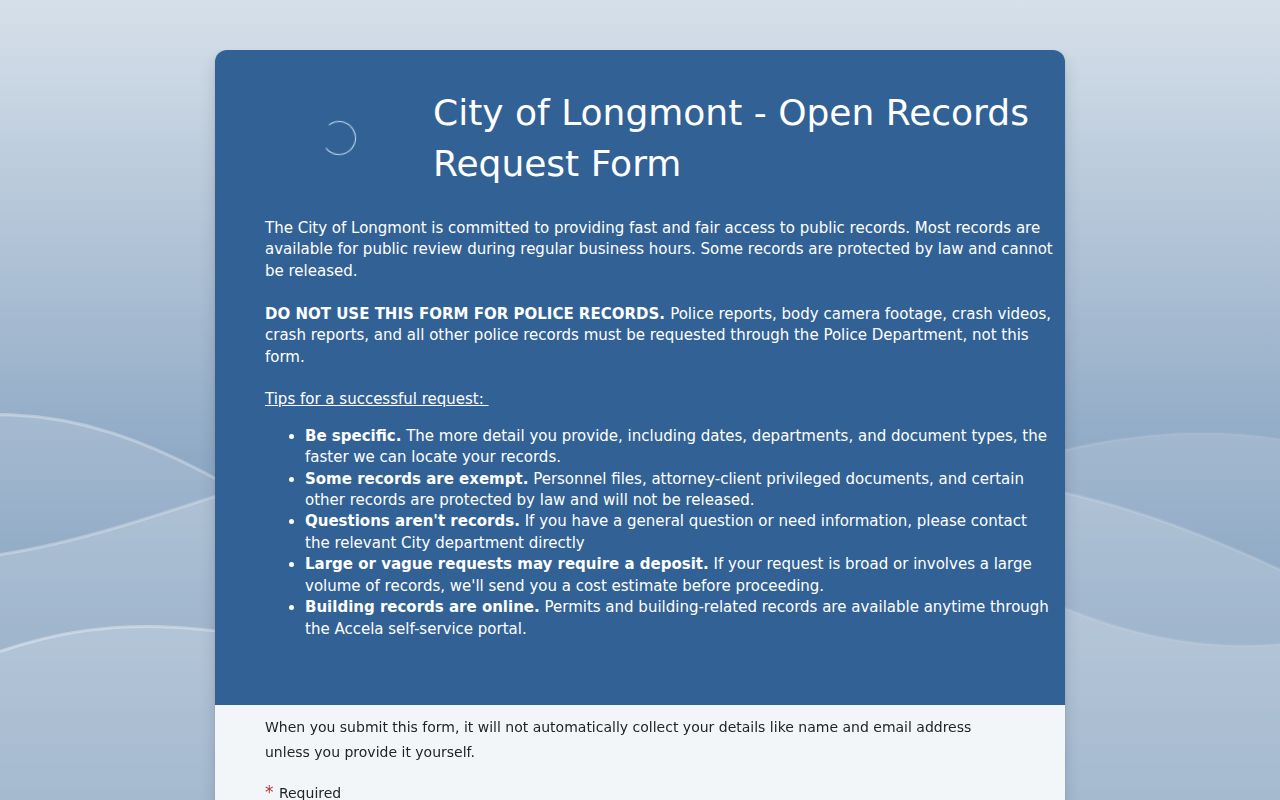
The city’s public-records request form is a fallback when the portal does not expose the needed record. CORA requests should name the records sought, rather than asking the custodian to create a new answer. Longmont’s process uses a three-working-day response baseline, possible extensions, a first research hour without charge, and stated research, copy, and format costs. Check the live policy before filing.
The Longmont Online Records portal is a self-service route for named city collections. The city request form is separate when a record is not already available online.
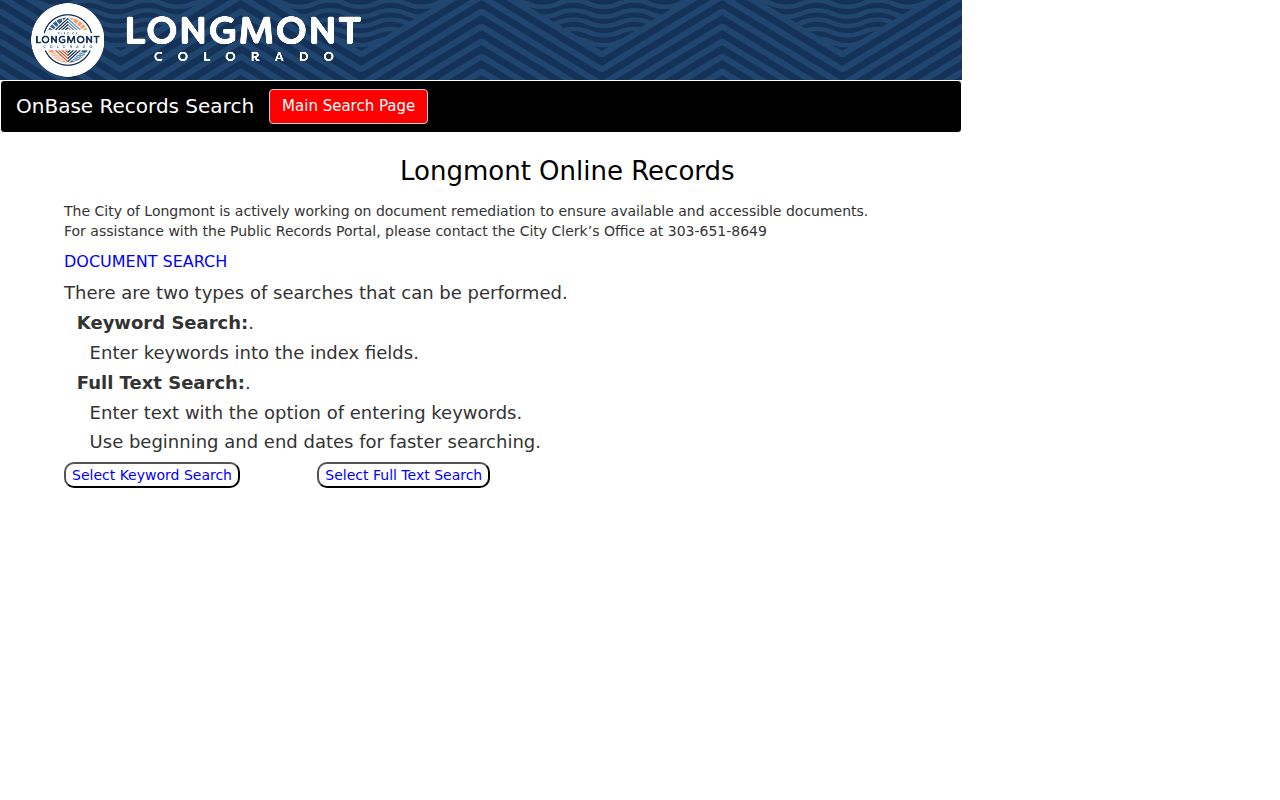
The online records screen shows the city’s keyword and full-text search path. Record the collection name and retrieval date because the portal carries a remediation notice.
The Longmont public-record request form is the next route when a self-service collection does not answer the question.
Note: A city meeting name is a civic connection, not proof of residence at the meeting location.
Longmont Courts and Vital Records
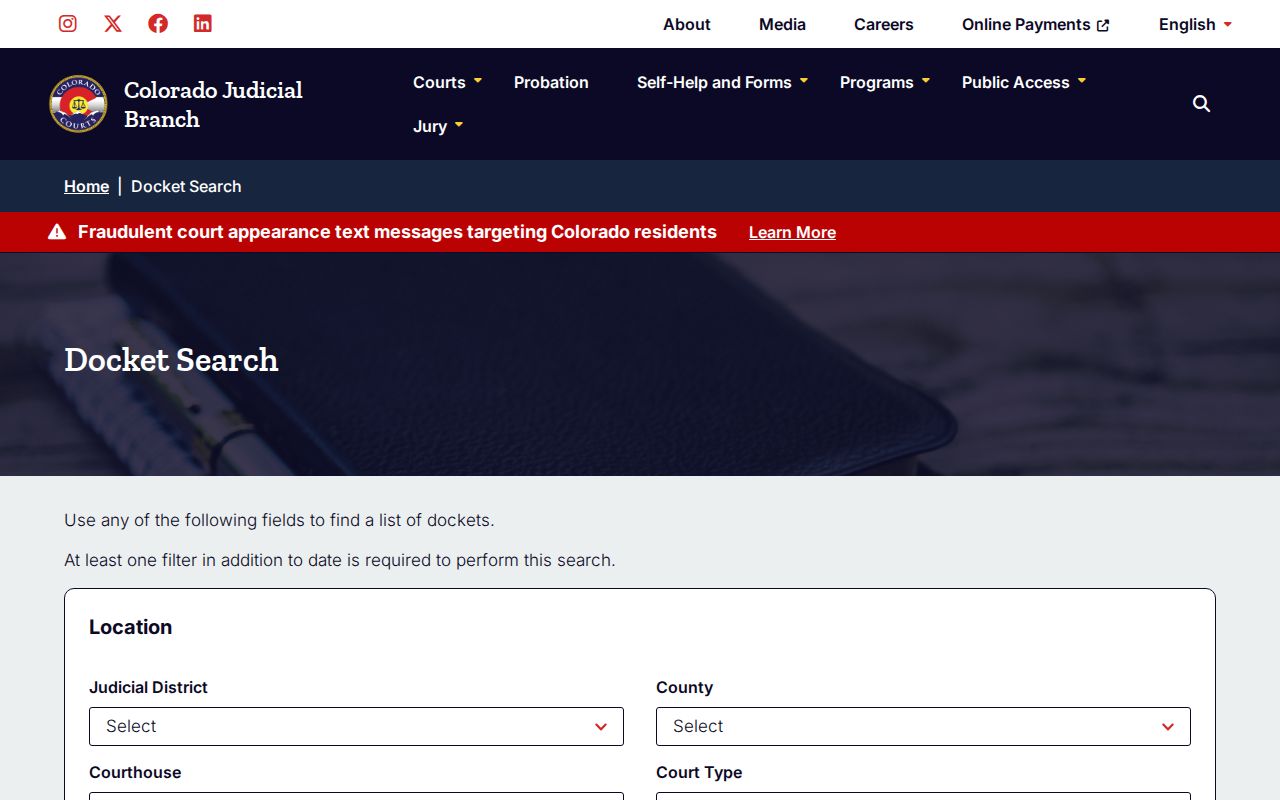
The Colorado Judicial Docket Search asks for a date plus another filter. Options include judicial district, county, courthouse, court type, division, date, case class, case sequence, party name, business name, attorney name, or attorney bar number. Run Boulder and Weld separately for a Longmont matter, then check Longmont Municipal Court for city-code citations. A docket list gives event and case context, not the full file.
For a decree, disposition, transcript, or complete party record, use the specific court clerk or court records request route. Boulder and Longmont records requests go through the state judicial records channel; Weld lists its file and records phone and email. Sealed, expunged, juvenile, adoption, and protected family-law details may not appear. The court’s current access policy balances public access with protected information.
Vital records are more closed. Under C.R.S. §25-2-117, Colorado treats vital statistics as confidential. There is no general public-opening year for a name-only birth, death, marriage, adoption, or divorce search. Eligible applicants submit identification and a direct and tangible interest or qualifying relationship. Boulder’s Longmont counter handles eligible birth and death requests; Weld handles Weld events; CDPHE and the State Archives provide state and historical routes.
The Colorado vital-records access page is the right starting point for an application, not a public index. Historical researchers shift to the State Archives, Longmont Ledger, cemetery and mortuary indexes, newspapers, directories, and probate. An obituary or newspaper notice is a lead, not a certified certificate.
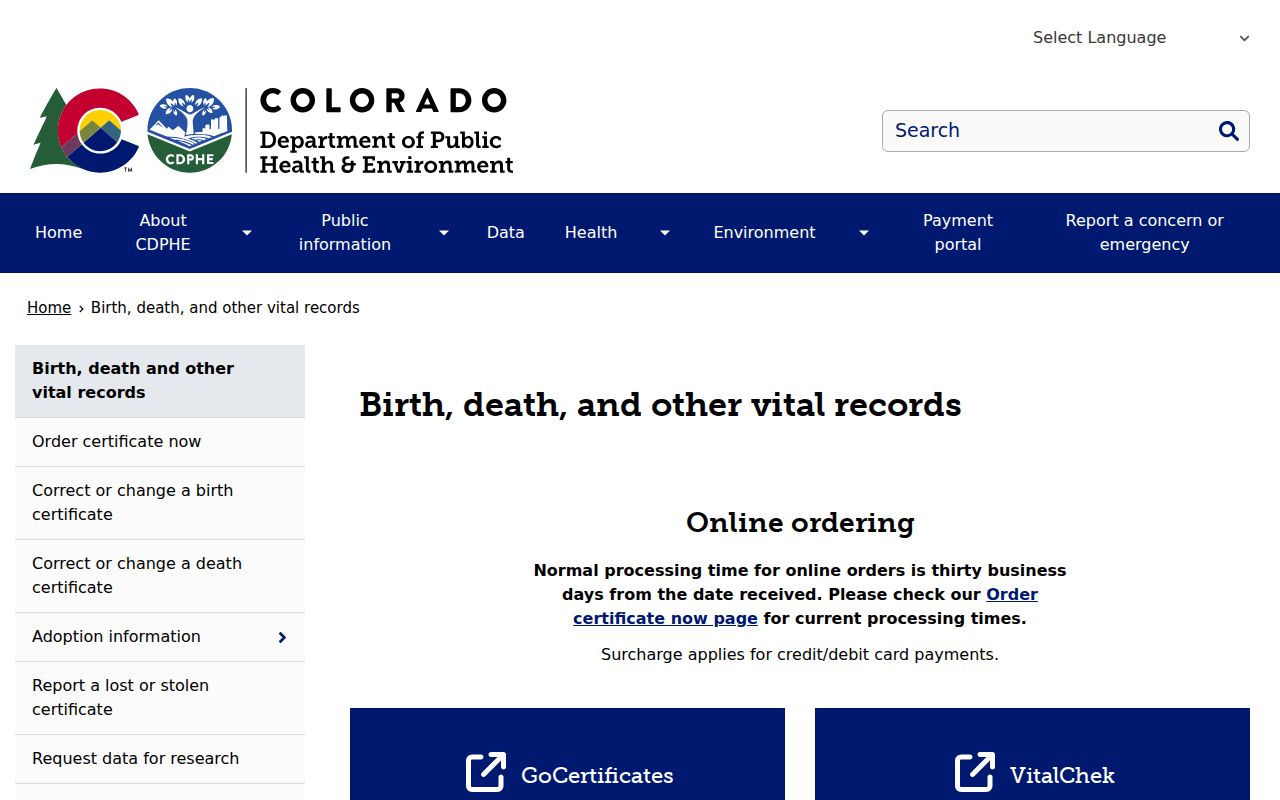
The Colorado vital-records screen points toward eligible applications and county or state custodians, not a public name search.
The Colorado Judicial Docket Search is the starting point for dated case-list research.
Old Longmont City Directories Preserve Address Clues
Longmont city directories survive in uneven runs. Local discovery identifies a 1910 volume; The Longmont city directory, 1912-13, includes rural routes and nearby Mead, Lyons, Hygiene, Niwot, and Highland Lake; other located years include 1921, 1928, 1932, 1936, 1938, 1940, 1943, 1949, 1951, 1953, 1955, and 1959. R.L. Polk leads the later run, with Longmont editions from 1966 through 1997 in Denver Public Library holdings. Combined Longmont-Boulder books can place the same person under a regional heading.
Later reverse directories matter when the name is unknown. The Library of Congress lists a Longmont-Boulder criss-cross run from 1991 through 1996. Search the street and number first, then move to the alphabetical entry for occupation, household context, or a telephone clue. A directory entry can describe a householder, boarder, business, subscriber, or post-office listing. It is not a complete current residents directory.
The Longmont city directory collections page gives the shelf, scan, and reading details. For a quick historical lead, the Longmont Public Library provides in-building Ancestry and FamilySearch access, HeritageQuest, monthly genealogy help, and a route to Longmont Archives.
Longmont ZIP Routes Do Not Settle Parcels
USPS identifies 80501, 80502, 80503, and 80504 as the current city-facing Longmont ZIP set to test. The postal system is not a city boundary. 80502 has a PO Box and processing role associated with 80501, 80503 serves west and southwest areas and county-side addresses, and 80504 reaches east and southeast postal territory. USPS routing labels can change without moving a parcel or city line.
Two historical clues matter. USPS deleted 80542 effective March 1, 2019. A 2022 routing bulletin changed 80540’s container label from Longmont 80501 to Longmont 80503, while 80540 itself is associated with Lyons rather than a regular Longmont city ZIP. Keep the original mailing line in historical work, then compare the current situs and county parcel.
ZIP searches group mail routes. Assessor and GIS searches group parcels. The Longmont ZIP directory separates those uses and shows how to move from a verified postal address to the right county record.
Longmont search tip. A postal ZIP can guide the first lookup, but only the assessor parcel, legal description, and county system establish the record jurisdiction.
Longmont Ledger Cards Bridge the Old Rolls
The Longmont Genealogical Society’s WPA-derived Ledger index extracts birth, marriage, and death notices from September 12, 1879 through 1935. The listed date is the newspaper publication date, not necessarily the event date. Early issues are missing from the Colorado Historic Newspapers Collection, so a Ledger hit should be checked against the original page or library microfilm when the date matters.
The Society’s projects also include mortuary, newspaper, obituary, voter, cemetery, family-record, and local-history indexes. Its voter extraction covers 1898 through 1919 and can show name, address, ward, age, marital status, occupation, and physical description. The Quarterly Index points into street, election, naturalization, school, organization, water-permit, and other subjects. These are powerful historical resident leads because they connect a surname to a place and date that modern portals do not cover.
Shaw Mortuary records add a clear preservation lesson. The originals were destroyed in a 2013 fire, but reproductions and indexes survive for roughly 1882 through 1945. Treat the surviving material as an index or reproduction. It can lead to a newspaper, cemetery, archive, probate file, or eligible certificate without pretending the lost original was inspected.
For an entity or professional connection, the Colorado Secretary of State business search accepts business, trade-name, trademark, ID, and document-number queries. It is a filing registry, not proof of residence.
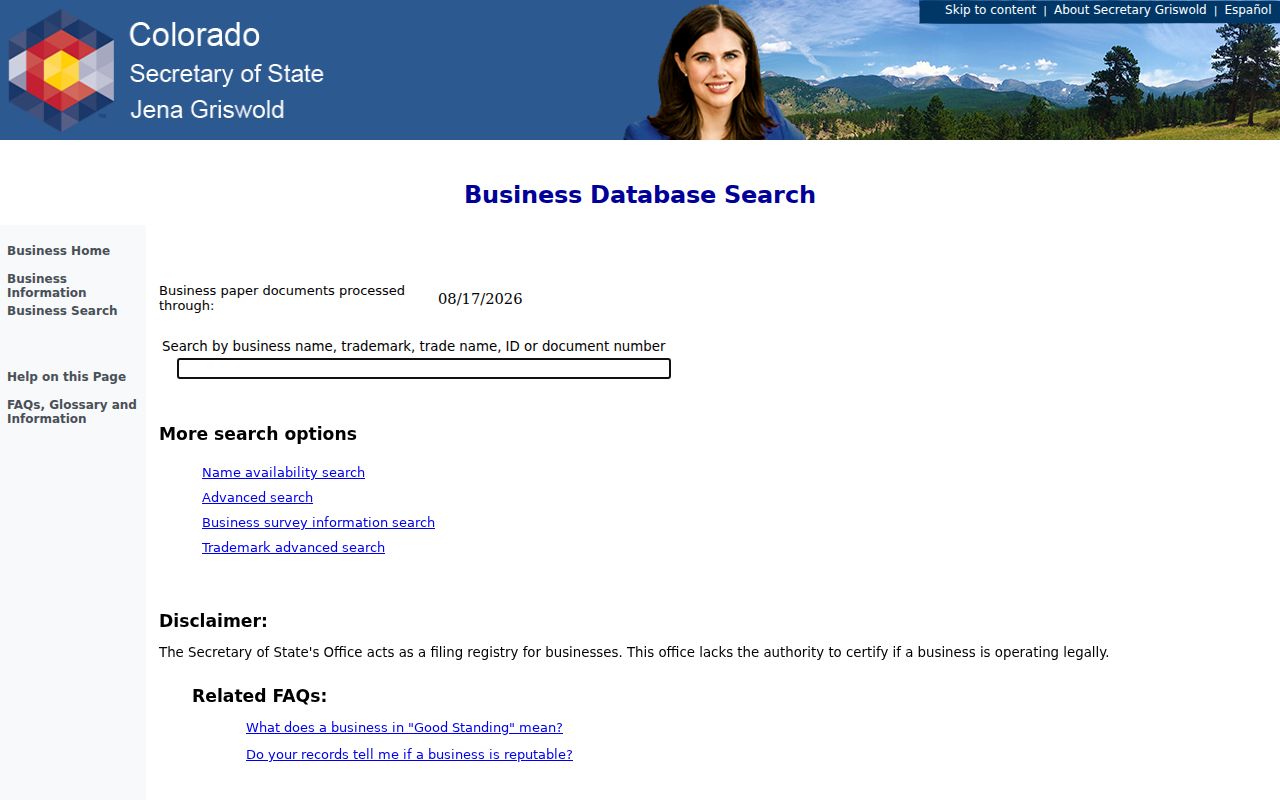
The SOS search screen demonstrates a useful side route when a name is tied to an entity. Keep the registered-agent or principal address separate from a residential address.
Longmont Owners, Households, and Deed Trails
For a house history, preserve the parcel key before chasing names. The assessor supplies account, parcel, legal description, and sales-history clues. The recorder shows the instrument, grantor, grantee, reception number, recording date, and sometimes the grantee mailing address. Search the current grantee, read the deed, then search the prior grantor as an earlier grantee. A quitclaim, trust, estate, lien, or deed of trust can explain a name change without marking a normal sale.
Pair each deed date with the closest city directory and census year. The deed answers title. The directory answers a printed address and occupation. The census answers a household at an enumeration date. Permits and historic maps add building chronology. A Longmont address can change through an annexation, subdivision, parcel split, merge, or street-number change, so the legal description and map geometry must stay with the notes.
- Roll
- A recurring government list, such as an assessment or voter record, with a defined purpose.
- Index
- A finding aid. It points to a record but may not show the underlying instrument or complete file.
- Criss-cross directory
- An address-first directory that turns a street and number into an occupant or subscriber name.
- Parcel
- A mapped tract identified by a county account or parcel number and a legal description.
Longmont Archives Catch What Portals Miss
Longmont Archives is on the second floor of the Longmont Museum at 400 Quail Road. Appointments run Monday through Friday, 9 a.m. to 5 p.m.; the archive contact is 303-651-8370. Staff can search house and building history, historic photographs, letters, diaries, maps, business and school records, and Times-Call clippings. The clipping collection is about 400 boxes from roughly 1967 through 1991, with inventory still in progress.
The Museum describes more than 80,000 photographs overall and more than 5,000 online. The St. Vrain Historical Society maintains an appointment-only community research library at Historic Hoverhome, 1309 Hover St., with a referral route to other local collections. The Library’s genealogy help is free on the last Saturday of each month, 10 a.m. to noon, and connects researchers with local volunteers.
State Archives adds historical birth, death, naturalization, government, and county record groups. The Archives catalog is not a general resident directory. Search by creator, title, date, category, archive number, place, organization, or street, then request the specific collection. A photograph caption or oral-history lead can narrow a search, but it still needs corroboration from the record custodian.
The Longmont Archives information page is the best route for an address-based appointment. The Longmont Public Library genealogy page explains in-library database access and volunteer help.
Safe Longmont Record Use and Stop Rules
Public access is not a command to publish a person’s address. Colorado’s Address Confidentiality Program can provide a substitute address and mail forwarding for eligible survivors, protected health-care workers, and other covered participants. Voter confidentiality rules and HB25-1195 add protections for eligible voters. Recorded documents should be filed with sensitive identifiers redacted, and DMV records remain protected under the federal Driver’s Privacy Protection Act.
The Colorado Address Confidentiality Program is the official protection route for eligible participants. It should be consulted before treating an address field as publishable.
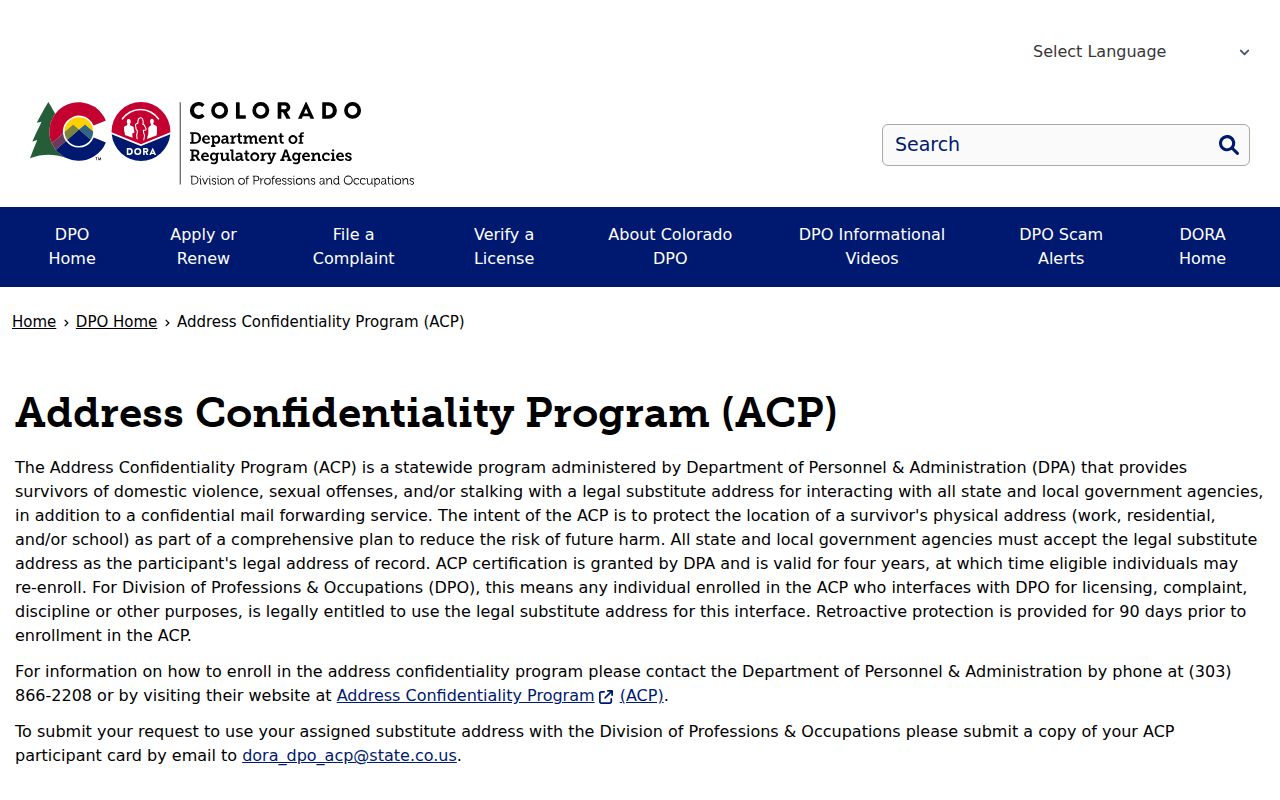
The confidentiality-program screen explains the substitute-address and mail-forwarding concept. A protected address is a stop rule, not a puzzle to reverse.
Stop when sources conflict, a record is restricted, or identity is not clear. A same-name hit is not enough. Keep the date, county, record number, and source role. Correct an error with the actual assessor, recorder, court, clerk, DORA, CBI, or city custodian. If a property-copy notice, court text, or government message asks for gift cards, cryptocurrency, or urgent payment, leave the message and call the official number from the custodian’s site.
Lawful personal use. Longmont records support genealogy, house history, civic research, reconnecting, and careful source checking. Do not use a record to stalk, harass, threaten, or harm another person.
| Question | Best first source | Stop rule |
|---|---|---|
| Who owns the parcel? | County assessor, then recorder | Do not call the owner an occupant without another source. |
| Was a person registered? | Go Vote or lawful county report | Do not treat a missing match as proof of absence. |
| Who lived there before? | Deed, directory, census, newspaper | Keep title, household, and event evidence separate. |
| What happened in court? | Docket, then clerk file | Do not treat a docket list as the complete case. |
Longmont’s residents directory works best as a source map. Start with the narrowest official record, record what it actually says, then move outward only when the next question requires it. That method preserves the difference between a current owner, a registered voter, a former householder, a civic participant, and a person who merely shares a name.