
Longmont City Directory Years and Shelves
Longmont city directory coverage is real but uneven. Local catalog work identifies early volumes, Polk runs, combined Longmont-Boulder books, telephone material, and a reverse-directory window. Some years have a catalog lead without a public page image. Treat each edition as its own source and confirm the title, publisher, place heading, and page access before promising a year to a researcher.
| Collection | Years | Where held | Access |
|---|---|---|---|
| Longmont city directory | 1910 | FamilySearch, Ancestry, DPL, library discovery | Check catalog and image rights |
| The Longmont city directory | 1912-13 | Local library and genealogy routes | Publisher and call number need verification |
| Longmont and combined regional volumes | 1916-1932 and selected later years | FamilySearch, Ancestry, DPL, library | Search Longmont and Boulder headings |
| R.L. Polk Longmont editions | Generally annual from 1892; located runs include 1921-1959 and 1966-1997 | DPL Western History and local collections | Year-by-year gaps require checking |
| Longmont-Boulder criss-cross | 1991-1996 | Library of Congress guide and holdings | Address-first, edition-specific |
| Telephone books | Edition-specific | DPL Colorado Directories Index and library help | Search town, exchange, and nearby headings |
The span does not mean every year is online. DPL’s Colorado directory index, FamilySearch, Ancestry access through the library, and local staff help are complementary. A combined volume may include Longmont, Boulder, rural routes, Mead, Lyons, Hygiene, Niwot, or Highland Lake. That wider coverage is useful, but it can place a person under a regional heading that a modern city search would miss.
See the Longmont Library genealogy service before making a shelf trip. It explains the library’s databases, local help, and Archives connection.
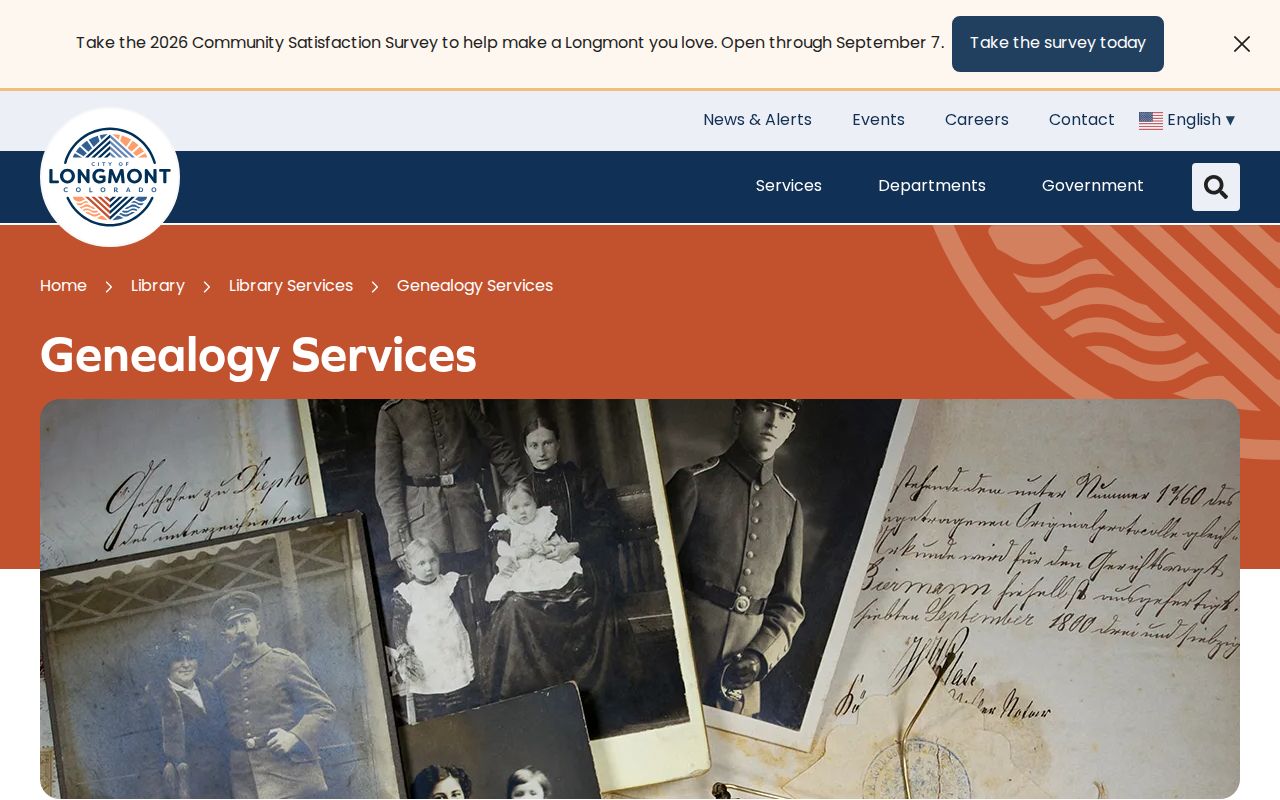
The library genealogy resource screen shows the practical access layer behind the Longmont city directory collections. Some databases work only on a library computer or library Wi-Fi.
Longmont Library and Archives Fill Shelf Gaps
Longmont Public Library offers free monthly genealogy help with Longmont Genealogical Society volunteers on the last Saturday, 10 a.m. to noon, on the second floor. Ancestry.com and FamilySearch access is available on a library computer or library Wi-Fi. HeritageQuest adds local-history books, federal census material, Revolutionary War pension files, Freedman’s Bank records, and PERSI subject indexing. Staff can help when an old volume is known by title but not by a searchable image.
Longmont Archives occupies the second floor of the Museum at 400 Quail Road. Appointments are Monday through Friday, 9 a.m. to 5 p.m.; call 303-651-8370. Its collections include photographs, letters, diaries, maps, business records, school records, and Longmont or St. Vrain Valley material. The archive can take old-house, downtown-building, historic-photo, and Times-Call clipping requests. The clipping collection is about 400 boxes from roughly 1967-1991, with inventory still under way.
The St. Vrain Historical Society maintains an appointment-only community research library at Historic Hoverhome, 1309 Hover St. Its resource page points researchers toward the Museum, History Colorado, the Historic Preservation Commission, and the Society’s sites. These repositories do not replace a city directory. They supply the address, organization, photograph, or newspaper clue that makes the right volume easier to find.
The St. Vrain Historical Society resources page is the source for the appointment and referral route.
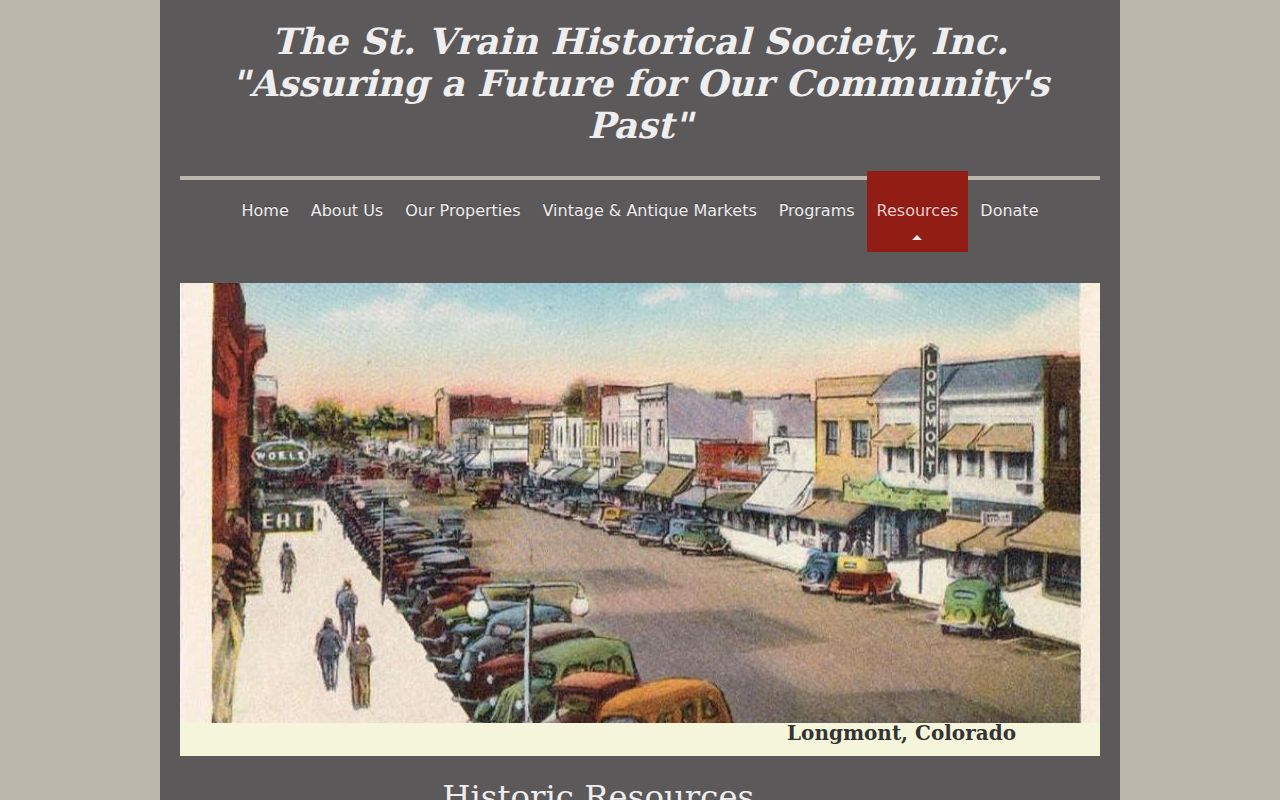
The St. Vrain Historical Society resources page illustrates the local referral network. Appointment access is part of the record trail, not a sign that the collection is absent.
What a Longmont City Directory Entry Reveals
A printed entry should be read as a bundle of fields. The same name may appear as a householder, business owner, boarder, subscriber, widow, or person connected to another household. Occupation and address help separate same-name people. Spouse or family notation can add a relationship clue, while the front “City Record” pages can explain officials, wards, schools, churches, organizations, street names, and changes.
| Name | Indexed person or head of household, sometimes with spelling or abbreviation variants. |
|---|---|
| Occupation | Work or business role that can distinguish two people with the same name. |
| Address | House number, street, rural route, post office, or business location. |
| Family clue | Spouse or parent notation where the edition includes it; treat it as a clue. |
| Owner or renter mark | Some runs use householder or residence symbols. Read that edition’s key first. |
| Business or telephone line | May connect a person with a shop, exchange, firm, or subscriber address. |
- Criss-cross directory
- An address-order section. Start with a street and number, then carry the occupant name to the alphabetical pages.
- Householder index
- A name-led list of household heads or principal residents, usually narrower than a full family list.
- Abbreviation key
- The volume’s legend for occupation, marital, residence, or business marks. Photograph it before reading entries.
- Enumeration district
- A census area used by an enumerator. It helps align a directory address with the right census schedule.
Directory conventions are not proof of a complete household. A person can be missing because they moved, declined listing, appeared in another town heading, or fell in a missing edition. A directory result should be compared with a deed, assessor parcel, voter register, census, obituary, or permit.
Longmont Criss-Cross Starts at the Curb
The Library of Congress address-directory guide lists Longmont-Boulder criss-cross material for 1991-1996. A reverse search is useful when a house history has an address but no name. Look up the street and number, note the occupant or subscriber, then find that name in the alphabetical city directory. The second entry may add occupation, spouse notation, a business, or a new address.
Normalize old street wording with care. Longmont’s original 1871 grid, Main Street, historic additions, ward boundaries, and later annexations can change how the same land is labeled. The 1912-13 volume also includes nearby communities and rural routes. Search Longmont, Boulder, Mead, Lyons, Hygiene, Niwot, and combined Longmont-Boulder headings instead of treating a failed town search as proof that no entry exists.
DPL’s directory guidance distinguishes city, householder, reverse, business, and telephone books. The Colorado index can identify a title or year even when the image is held elsewhere. Use the Library of Congress criss-cross guide for the address-first logic, then ask the Library or DPL where the specific edition can be viewed.
Trace a Longmont Household Across Years
A household trail works best as a series of snapshots. Pick an address and an approximate year. Use reverse material if the name is unknown, or the alphabetical pages if it is known. Keep every spelling, occupation, spouse clue, and address change. Pair the directory with a census year, deed date, voter register, permit, obituary, or newspaper rather than asking one volume to answer every question.
- Start with the closest available Longmont edition and record the complete entry, including street wording and symbols.
- Check the preceding and following editions. A disappearance may be a move, a missing issue, a name change, or a new town heading.
- Pair the entry with the nearest released federal census. Census composition and directory occupation or address are related but not interchangeable.
- Compare the address with the assessor parcel, deed legal description, permit chronology, or historical map to test continuity.
- Close a former-resident trail with the Ledger, newspaper, obituary, mortuary, cemetery, probate, or next directory when the source permits.
The Census releases images under a 72-year rule, so the available year set changes over time. Boundaries and enumeration methods also differ. Mark an address as “near” or “in the same parcel” only when the source supports that link.
Note: A directory omission is an unresolved gap, not evidence of death, departure, or a missing household.
Longmont Ledger and Newspaper Cross-Checks
The Longmont Genealogical Society’s Ledger index spans notices published from September 12, 1879 through 1935. It was drawn from a WPA card file at the Library. The date on a card is the newspaper date, not necessarily the birth, marriage, or death date. The index is valuable because it can bridge a directory surname or address into an event notice, but the original newspaper page is the stronger source.
The Longmont Ledger index is the source for the surname and event lead shown here.
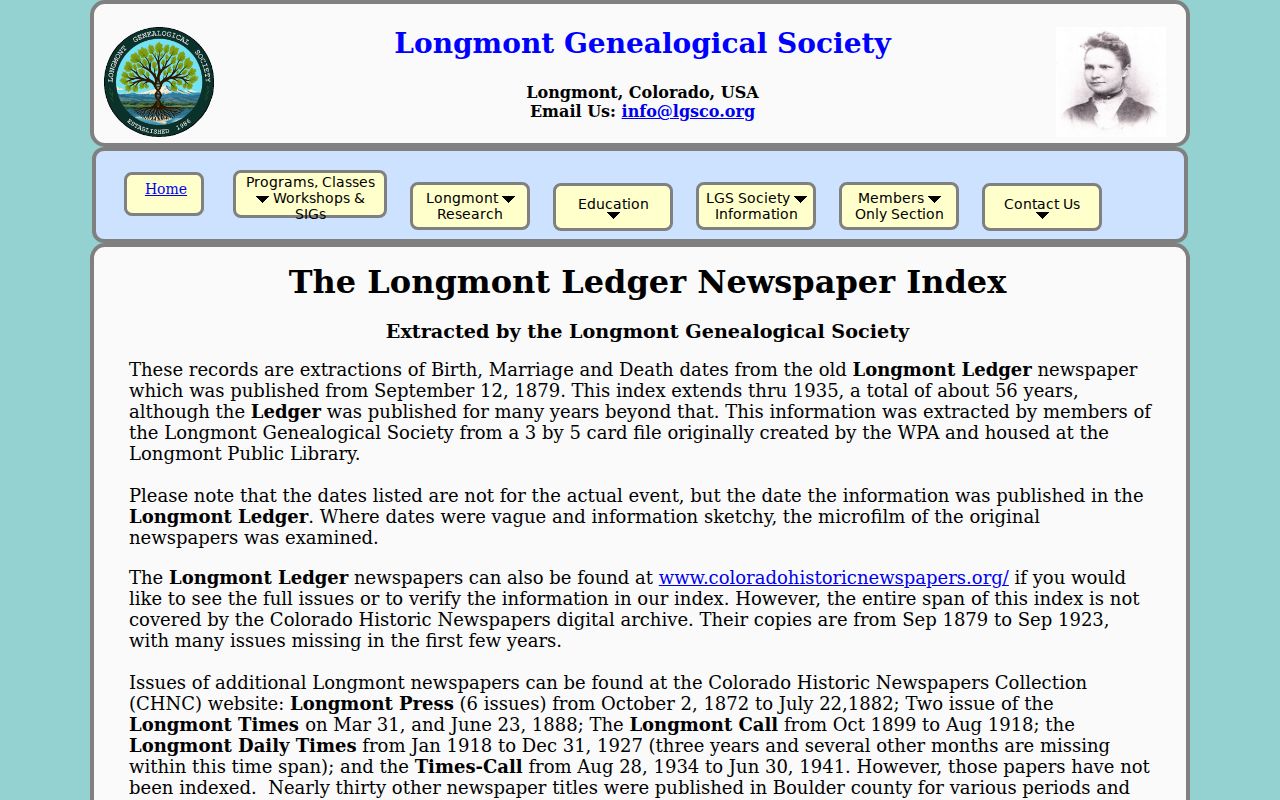
The Longmont Ledger index shows the kind of local surname and event lead that a general city directory may not contain.
Colorado Historic Newspapers Collection coverage is incomplete. Longmont Ledger runs from September 1879 to September 1923 with many early issues missing; other local titles include Longmont Press, Longmont Times, Longmont Call, Longmont Daily Times, and Times-Call in edition-specific spans. Longmont Archives holds Times-Call clippings from roughly 1967-1991, while the Shaw Mortuary project reconstructs many records from about 1882-1945 after the originals were lost in a 2013 fire.
Use a notice as an event lead, not a certified vital record. An obituary can give a former address, relative, funeral home, or cemetery clue. Probate and deeds can then test the property connection. A city directory remains the address and occupation snapshot in that chain.
The Longmont Genealogical Society projects page is the source for the voter, mortuary, obituary, cemetery, and local index routes shown here.
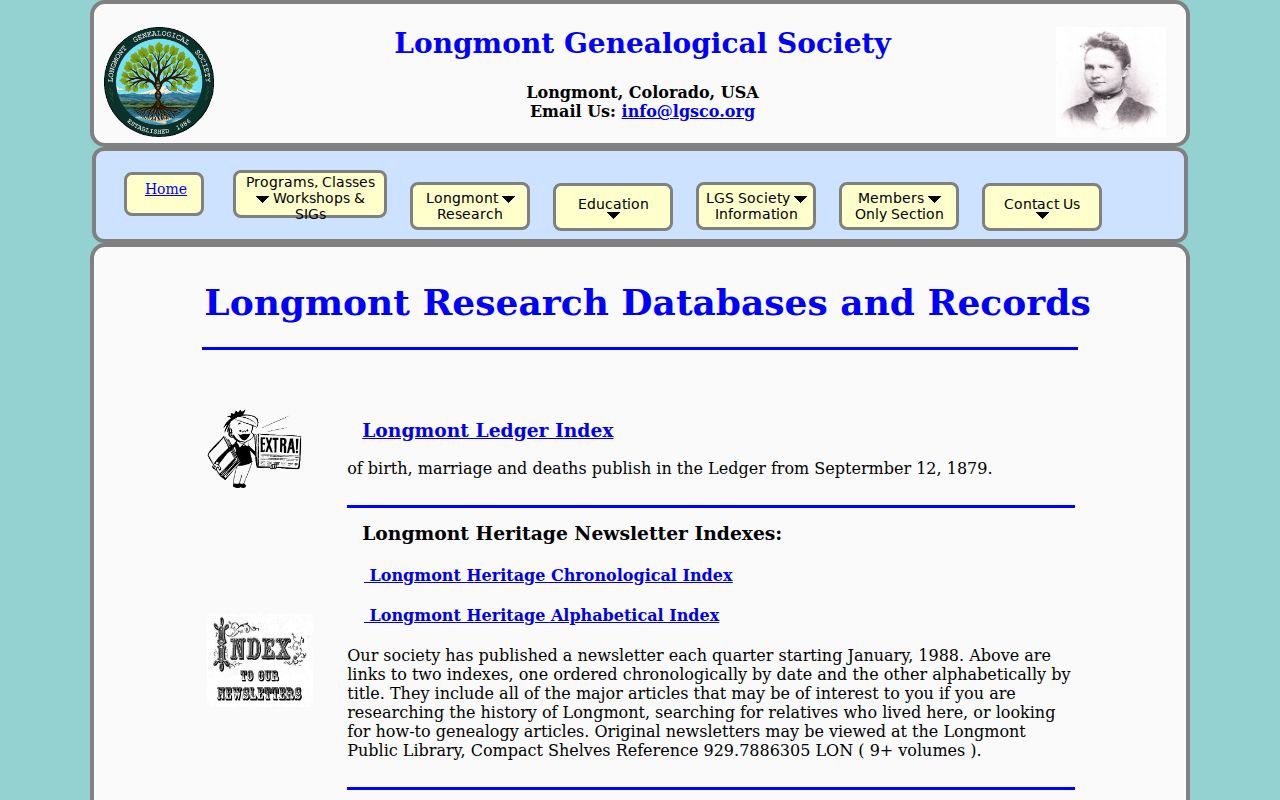
The Longmont Genealogical Society projects page gathers voter, mortuary, obituary, cemetery, and local index routes that complement the city directory shelf.
Longmont History Gives Directory Years a Place
Longmont’s records have a strong place-and-date texture. The Chicago-Colorado Colony laid out the town in 1871. The railroad arrived in 1873. A 1879 fire destroyed much of the east side of the 300 block of Main Street, after which the brick commercial core grew. The Carnegie library opened in 1913. These anchors can explain why a street, business, or institution appears differently across a directory year.
Industrial and civic eras leave distinct clues. The Empson cannery began in 1889, the Great Western Sugar era began in 1903, Gibson tractors operated after 1946, and IBM arrived in 1965. A person may appear under a business, organization, ward, school, church, or neighborhood heading rather than as a plain household entry. Search the institution with the street and year.
The Longmont Museum, St. Vrain Historical Society, DPL, Library of Congress, and State Archives add maps, photographs, manuscripts, and government records. A 1915 police-history case tied to 303 Coffman Street and a 1941-45 POW dormitory near Third and Kimbark are tightly sourced place-and-date leads, not proof that any particular person lived at those locations. Local color works when the record role stays clear.
When a Longmont Directory Year Is Missing
Move sideways before giving up. Search the Denver Public Library Colorado Directories Index, FamilySearch’s United States City and Business Directories collection, Ancestry from a library connection, the Library of Congress, the local library, and the St. Vrain Historical Society. A combined regional edition may contain the person under Boulder or a rural route. A telephone book may be filed by exchange or nearby town.
FamilySearch describes a collection running approximately 1749-1990 with indexed first and last names, residence, occupation, place, life event, family-member, keyword, and image controls. A result may have an image, film, affiliate restriction, or no accessible page. The DPL digital directory collection provides name, place, year, title, page, and image searches for edition-specific material.
For a building rather than a person, use the Library of Congress Sanborn maps for Longmont reviewed at 1890, 1895, 1900, 1906, 1911, and 1918. They show building footprints, uses, lots, and street labels, not resident names. Pair the closest sheet with a deed, directory, census, or newspaper. The point of a city directory is the human entry. The surrounding archive explains why that entry belongs at that address.
Note: Record a missing year and the search route used; do not silently turn a catalog gap into a fact about the household.
Start a modern parcel question on the Longmont by-street page. Start a one-person confirmation on the Longmont resident lookup page.